
Phoenix Water Damage Restoration in Tenafly: A Homeowner’s Guide
A damp wall stud can test dry on a surface meter and still carry enough hidden moisture to grow mold colonies within five days. That single fact trips up both panicked homeowners and crews who stop short of a full moisture log. In Tenafly, where older colonial homes have been absorbing Bergen County groundwater for decades, full-cycle water damage restoration is not a luxury. It’s the difference between a one-visit fix and a structural problem that resurfaces for years.
If you’re standing in a wet basement right now, the short answer is this: water damage restoration in Tenafly means extraction first, structural drying second, and rebuild third, all handled by one certified crew with a written moisture log at the end. If you’d rather not manage that yourself, call (551) 348-3742 and a live dispatcher will send someone same visit.
The 72-Hour Window That Decides Everything
Most Tenafly homeowners don’t realize the water damage itself rarely causes lasting structural harm. It’s the 72-hour window after the flood where incomplete drying decisions lock in the real cost. Water wicks up drywall, travels along sill plates, and saturates the bottom plates of framed walls faster than most people expect. If those materials are not dried to the proper standard before drywall goes back up, the moisture stays trapped inside the wall cavity.
What happens next is predictable. Mold colonies establish within three to five days in a dark, warm, damp wall cavity. The surface looks fine. The paint holds. The homeowner moves on. Then next spring, or the spring after that, a musty smell creeps back through the baseboards in the finished basement over on Knickerbocker Road, or the hardwood in a colonial off East Clinton Avenue starts cupping. By then, the remediation scope is twice what the original drying job would have been.
This is why Water Damage Restoration in Tenafly should not be judged by how fast the standing water disappears. It should be judged by whether the crew can prove, with daily readings, that the structure actually dried.
Phase One: Extraction and What Most Crews Skip
Extraction is the least complicated phase and the most often rushed. The goal is not just to remove standing water. It’s to remove enough water that the drying equipment can do its job within a reasonable timeline. A homeowner with a shop vac can pull surface water. A certified crew uses truck-mounted or portable extraction units that pull water out of carpet pad, subfloor, and wall cavities.
What most crews skip: mapping the water’s travel path before setting equipment. In Tenafly’s older housing stock, water doesn’t just pool where you see it. It follows the path of least resistance along floor joists, down wall cavities, and into adjacent rooms that look untouched. A proper extraction starts with a moisture map. We read the affected area with penetrating and non-penetrating meters, mark the boundaries of saturation, and document those readings. That map is the first page of the moisture log.
Homeowners should ask to see that map. If a crew cannot show you where the water went, they cannot prove they dried it all.
Phase Two: Structural Drying and the Clay Soil Problem
Bergen County’s clay-heavy soil affects Tenafly basements differently than slab-foundation homes in other parts of the state. Clay holds water against foundation walls longer than sandy soil does. The hydrostatic pressure builds against the outside of the wall, and over decades, even a well-built foundation develops micro-cracks. During a heavy rain cycle or a spring thaw, that pressure pushes moisture through those cracks and into the basement.
The practical result: a “minor” basement leak in Tenafly often means the concrete itself is still holding saturation days after the visible water is gone. Surface drying solves the cosmetic issue. Structural drying solves the real one. This is where equipment matters.
In Tenafly’s humid summers, refrigerant dehumidifiers struggle below a certain grain-per-pound threshold. They cool air to condense moisture out of it, which works fine in warm air but bogs down when the air dries. A desiccant dehumidifier uses a rotating wheel of silica gel to physically pull water vapor from the air, and it keeps working effectively even when the air is already fairly dry. That matters because the last 10 to 15 percent of moisture in a wall cavity is the mold zone. You want equipment that can reach that last ten percent.
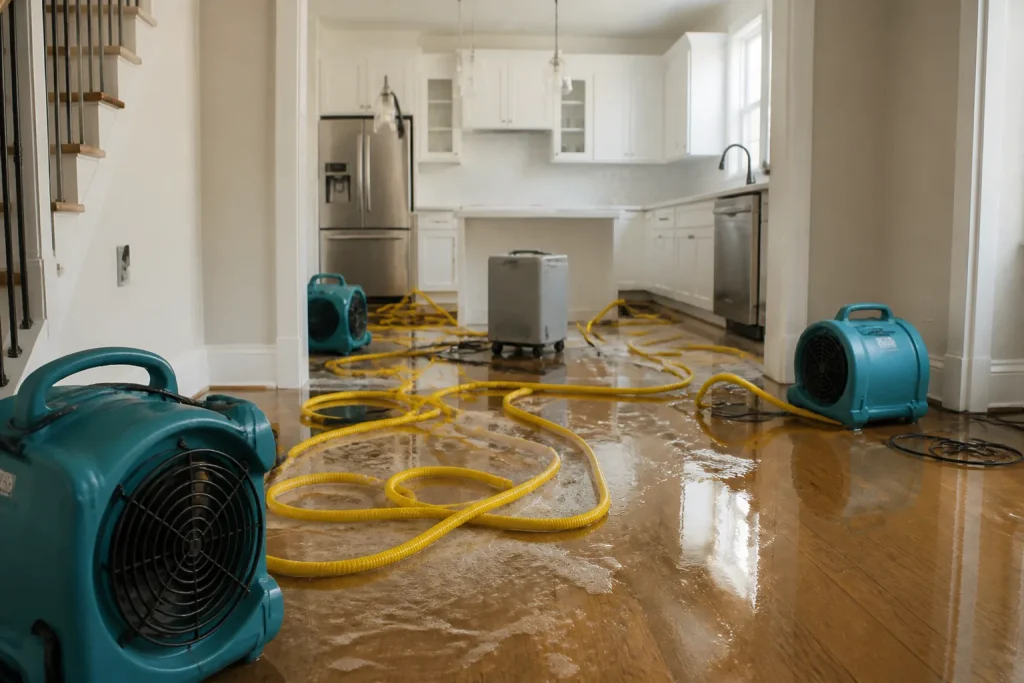
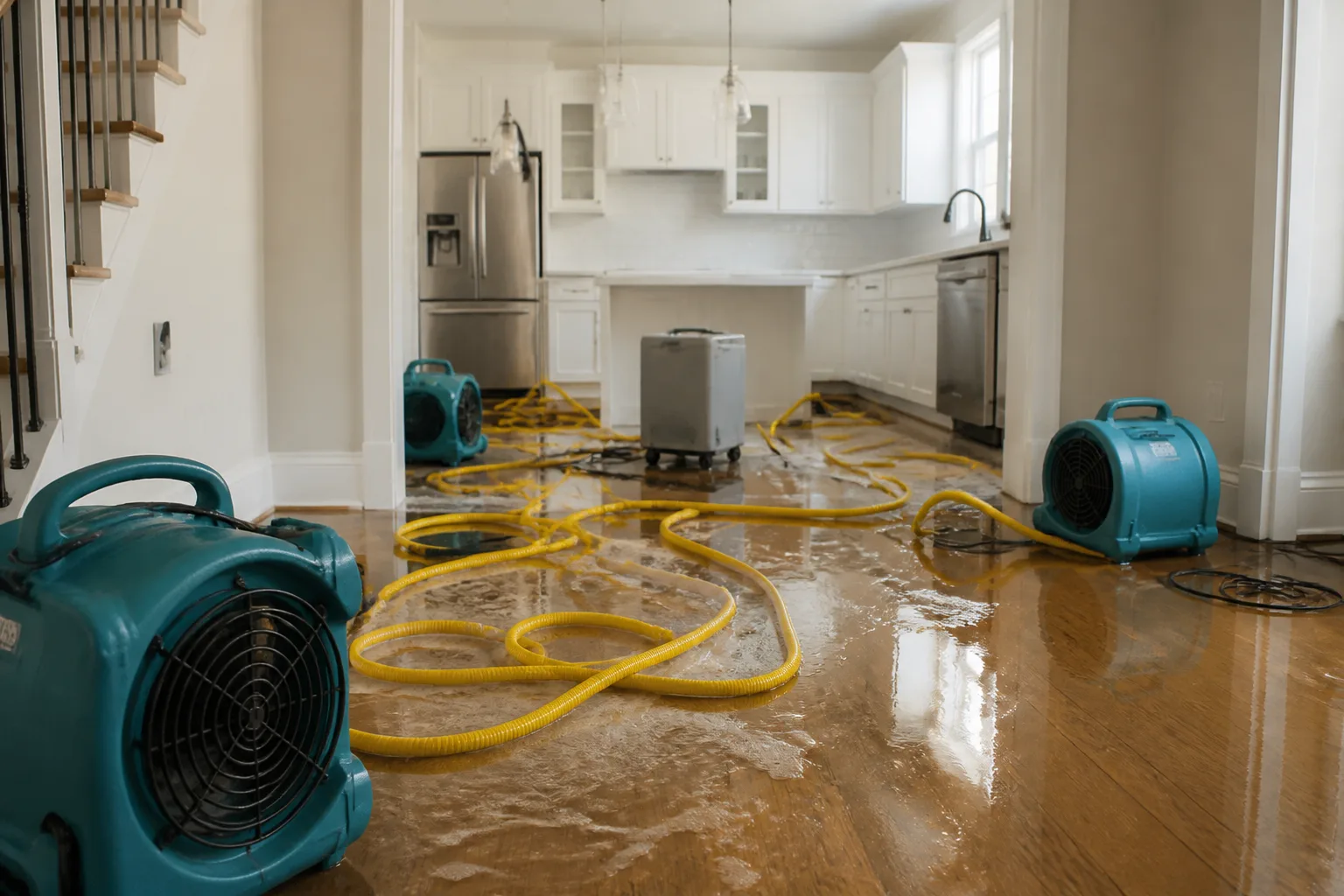
What to ask to see on-site: a mix of desiccant dehumidifiers, high-velocity air movers, and moisture meters with daily logged readings. Brands we run include Dri-Eaz and Phoenix, and every piece of that equipment is only as useful as the person reading the gauge and adjusting placement. If the drying plan is “set the fans and come back next week,” the homeowner is the one who pays for that shortcut.
Phase Three: Rebuild Without a Handoff
Here is where jobs go wrong in Tenafly’s older colonial housing stock. Most restoration companies handle extraction and drying, then hand the job to a separate general contractor for the rebuild. The homeowner becomes the messenger between two companies. The moisture log from the drying crew never makes it to the rebuild crew. The drywall goes up. The warranty is split between two parties who each point at the other when something fails.
Full-cycle restoration means one company reads the moisture map on day one, runs daily readings, hands the log to the homeowner and the carrier, and rebuilds what needs rebuilding. The same crew that dried the wall cavity is the crew that replaces the drywall and trim. There is no mid-job handoff. No inherited crew that never saw the moisture map. No argument about who signed off on what.
That continuity matters double in older homes. Tenafly has a lot of pre-war construction, plaster-over-lath walls, and true dimensional lumber. A rebuild crew that knows what the moisture readings looked like behind a plaster wall will make different decisions about how fast to close it up than a crew that inherits the job from a folder of paperwork.
What a Proper Moisture Log Actually Looks Like
The phrase “moisture log” gets thrown around a lot, so let’s be specific. A proper moisture log is a dated, room-by-room record of moisture readings taken with calibrated meters. It includes the drying goal for each material type, the equipment placement and settings, and a signature line for each reading. It is not a one-page summary at the end of the job. It is the running record kept during the job.
Why it matters for mold prevention: if a wall hits the dry standard on day four but the floor plate under the wall hits it on day seven, the log shows that. Without it, the assumption is that everything dried together, which is not how moisture behaves.
Why it matters for insurance: adjusters respond to documentation. A homeowner who can hand over a moisture log with daily readings, equipment benchmarks, and a final sign-off has a much stronger claim position than one who has an invoice and a promise. We bill the carrier directly and coordinate with the adjuster on the homeowner’s behalf, and the log is the backbone of that coordination. Photo documentation throughout the job serves the same function.
The 90-Day Window After Restoration
A written guarantee is only as useful as the inspection window it covers. Here’s what a 90-day post-restoration inspection should actually include: a re-check of moisture readings in the previously affected areas, a visual inspection for any staining, cupping, or texture changes, and an honest answer to the question “did anything come back?” If the drying was done right, the answer is almost always no. If something did come back, the guarantee should mean the crew comes back and makes it right without a paperwork battle.
That is the point of a guarantee in this trade. Not a piece of paper. A written commitment that a real company with a real local presence will stand behind the result. Nineteen years from now, the company that plans to still be in Tenafly is the company that shows up when a problem re-emerges. The one that was going to chase storms and disappear never left a number you could call anyway.
We’ve pulled baseboards off in homes over near Tenafly High School where a previous “restoration” from another company had sealed wet framing inside the wall. The homeowner paid for a drying job and got a coverup. The smell came back the following spring, just as it always does. The full fix cost three times what the original job would have if it had been done to the dry standard the first time.
That’s the Keystone Standard we put in writing with our 90-Day Done Right Promise. Krafted right. Every time. Your home first. Standing behind it. No arguing.
What a Square Deal Looks Like in Tenafly
This customer has lived in their house twenty years and plans to stay. They remember being burned by a contractor once. They do not want the cheapest bid. They want a square deal. That means background-checked, uniformed technicians in their home. A written scope before work starts. Direct insurance billing so the homeowner never plays messenger. And a live person answering the phone at two in the morning, not a recording.
We run most water damage jobs in a single visit. The same certified technician who reads the moisture map on day one handles daily readings, hands the log to the homeowner and carrier, and rebuilds what needs rebuilding. Properly dried means properly closed.
Related services for Tenafly homeowners: Mold Remediation in Tenafly often follows water damage that sat too long untreated, and Fire & Smoke Damage Restoration in Tenafly involves the same full-cycle discipline on a different kind of damage. Both run through the same crew and the same guarantee.
When to Call a Pro
Call a professional if the affected area is larger than a single bathroom, if the water sat for more than 24 hours, if it touched drywall, insulation, or finished flooring, or if the source involved sewage. That last one is not a DIY job under any circumstance. Category 3 water carries pathogens that require proper containment and disposal, not a mop bucket and a fan.
Call a professional also if you simply do not want to wonder. The cost of a proper moisture reading is trivial compared to the cost of finding out next spring that the drying was incomplete. If you’re in Tenafly and want the job done right and backed in writing, Floodline Restoration Co. offers free estimates. A live dispatcher answers at (551) 348-3742.
The Bottom Line
Water damage in Tenafly is a three-phase job: extraction, structural drying, and rebuild. The drying phase is where corners get cut and where the real cost gets locked in. A proper moisture log with daily readings, professional-grade equipment matched to Bergen County’s humid summers, and one crew seeing the job through from first extraction to finished rebuild is what “done” actually means.
If you’re in Tenafly and need help, Floodline Restoration Co. offers free estimates with no surprises on the bill. Call (551) 348-3742 and a live person picks up.
Frequently Asked Questions
How long does water damage restoration actually take in Tenafly?
Most structural drying jobs in Tenafly reach the dry standard in three to five days. The rebuild phase depends on the scope of finish work, but the drying phase should never be rushed past what the moisture meter says. Call (551) 348-3742 for a timeline specific to your home.
Will my insurance cover water damage restoration?
Most homeowners’ policies cover sudden and accidental water damage, such as a burst pipe or a failed appliance. Gradual seepage or long-term groundwater intrusion is often excluded. We document every job with photos and a moisture log, bill the carrier directly, and coordinate with your adjuster so you never play messenger. Call (551) 348-3742 and we can walk through your policy specifics.
Do I really need full restoration or just a good cleaning?
If water touched drywall, insulation, finished flooring, or wall cavities for more than 24 hours, you need professional drying, not just a cleaning. Hidden moisture inside wall cavities is what causes recurring mold and structural rot in Tenafly homes. A proper moisture reading tells you which one you’re dealing with. Our estimates are free at (551) 348-3742.
What does the 90-Day Done Right Promise actually cover?
It covers the restoration work we performed. If something in the previously affected area comes back within 90 days, we return and make it right at no charge. No paperwork battles, no arguing. It is the Keystone Standard, and we put it in writing on every job. Call (551) 348-3742 to have a written scope before any work starts.
Related Services in Tenafly
From the Floodline Restoration Co. home page, you can review our full range of restoration services. If water has been sitting long enough to raise a musty smell, see Mold Remediation in Tenafly. If a fire or smoke event requires the same full-cycle rebuild discipline, see Fire & Smoke Damage Restoration in Tenafly.
Written by Curt Bowman, Owner at Floodline Restoration Co., serving Tenafly since 2010.
What happens when you call
- 1
A real person answersNo phone trees - you reach a local pro.
- 2
You get an upfront price rangeHonest numbers before anyone is dispatched.
- 3
A background-checked tech heads outLicensed & insured, dispatched right away.
- 4
You approve before work beginsNothing starts until you say go.
Need Damage Restoration Help?
Call Floodline Restoration Co. - licensed & insured, here with fast after-hours help in Tenafly.
(551) 348-3742