
How to Choose the Right Damage Restoration Company in Tenafly
Choosing a damage restoration company in Tenafly comes down to one structural question: does the same crew that extracts the water also rebuild the walls? Most disputes, delays, and mold callbacks start at the handoff between a mitigation crew and a subcontractor. Ask that question first, and if you’d rather not spend the afternoon on the phone, call Floodline Restoration Co. at (551) 348-3742 for a straight answer.
We pulled a water heater out of a basement over near Roosevelt Common last spring where the homeowner had already gotten two bids. Both companies were going to sub out the drywall. Neither had told her that. She found out because she asked the question we’re about to give you in section one.
Key Takeaways
- Ask whether one company handles extraction, drying, and rebuild from start to finish.
- IICRC certification covers water damage standards, not the company’s ability to rebuild.
- A written guarantee should name moisture thresholds and reinspection dates, not just promise satisfaction.
- Direct insurance billing shifts documentation risk off the homeowner’s shoulders.
- Storm chasers vanish after the weather clears; verify a Tenafly physical address and local crew.
The One Question That Exposes a Split-Job Contractor
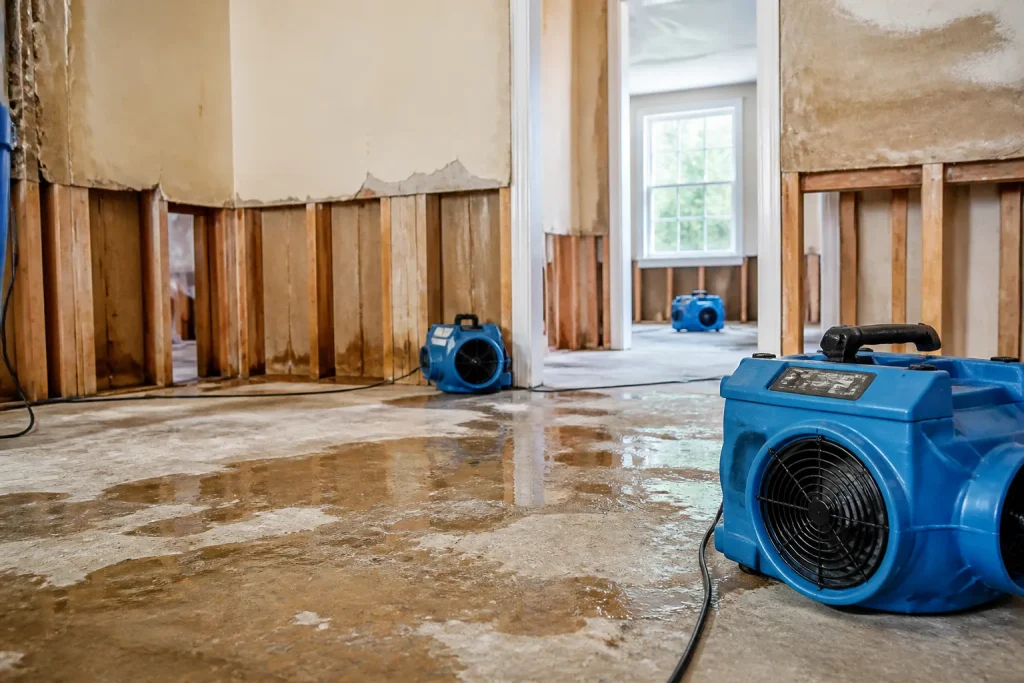
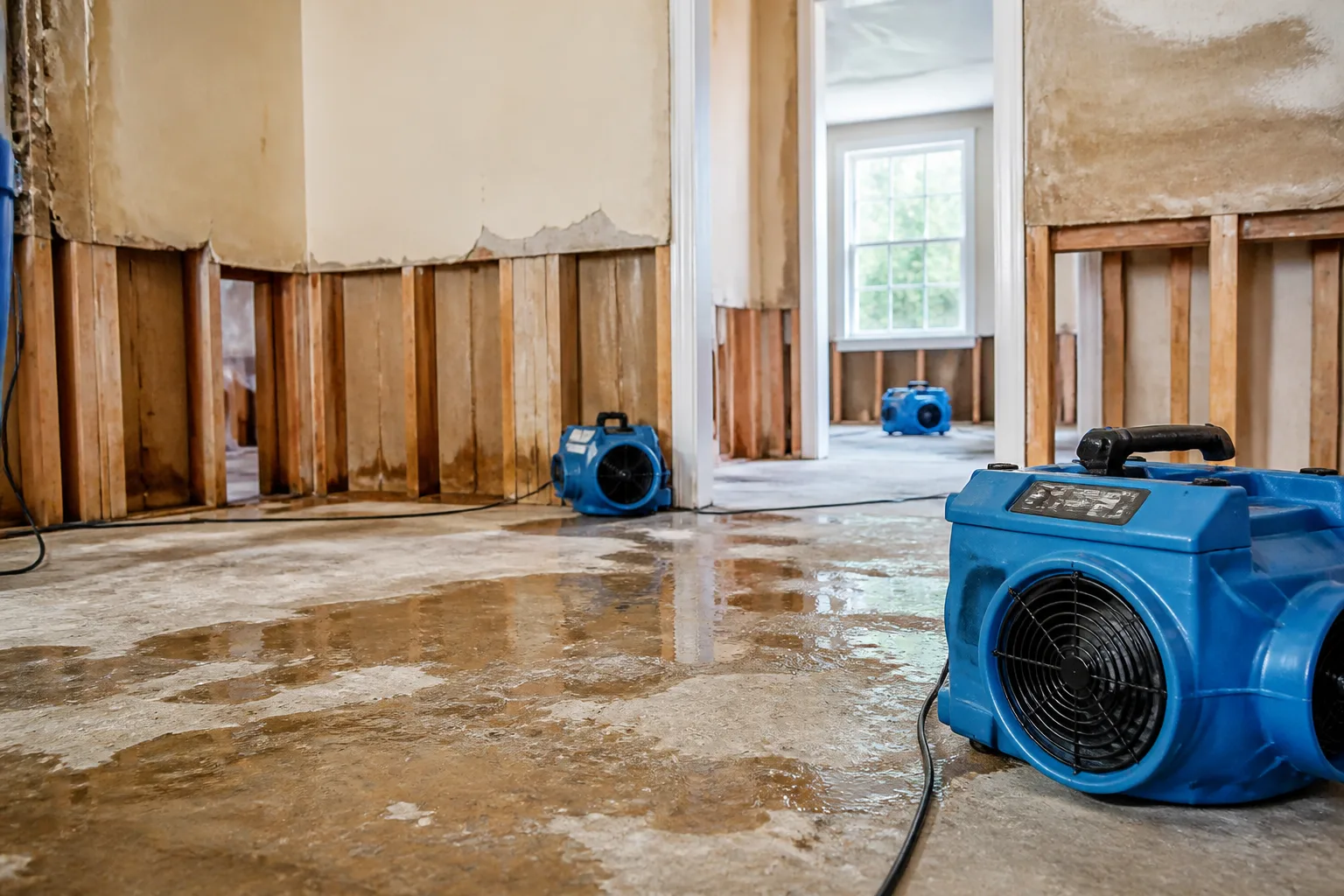
Of the restoration companies serving Bergen County, the majority subcontract at least one phase of the job, often reconstruction, to a third party whose work they cannot warranty. The marketing materials rarely say so. You’ll see the same stock photos of drying equipment on every site, and the same list of certifications. None of it tells you whether the crew that shows up on day one is the crew that finishes the trim on day thirty.
Here’s the exact wording to use when you call a restoration company in Tenafly: “If I hire you, will your own employees handle extraction, drying, and reconstruction, or will any part of the job go to a subcontractor?” Then be quiet and let them answer. A full-cycle company will say yes without pausing. A split-job operation will say something like “we coordinate with trusted partners” or “we handle the mitigation and bring in a great local contractor for the rebuild.” That’s the pause you’re listening for.
The reason this matters in Tenafly specifically is the age of the housing stock. A lot of homes in this town were built before 1960. Plaster walls, hardwood floors that have been refinished four times, joists that have settled into place over seventy years. A reconstruction subcontractor who has never seen the house before is working blind on materials that don’t respond the way new construction does. Our crews have pulled enough lath and plaster out of Tenafly basements to know what’s load-bearing and what’s just old. That knowledge doesn’t transfer through a change order.
We handle every phase with the same certified crew, from first extraction to finished rebuild. No handoff, no inherited crew, no warranty that dies at the property line between two companies. That’s the difference, and it’s the first thing you should verify.
What IICRC Certification Actually Covers - and What It Doesn’t
The IICRC S500 is the standard for professional water damage restoration. It covers the science of drying: how to classify water damage, how to set up drying chambers, how to measure moisture in different materials, and how to verify that a structure has reached a dry standard. It’s a real credential, and any company worth calling in Tenafly should have technicians trained to it.
But here’s what the S500 does not cover. It does not cover finish carpentry. It does not cover drywall taping. It does not cover cabinet installation, paint matching, or tile setting. A company can hold every water damage certification available and still have no in-house ability to put your kitchen back together. The certification tells you they understand how to dry a building. It says nothing about their ability to rebuild one.
We’ve watched homeowners treat the certification logo as a proxy for full-service capability, and that’s an expensive assumption. The S500 is a starting point, not the finish line. When you’re comparing restoration companies in Tenafly, ask what the rebuild crew looks like. Are those carpenters on the company’s payroll, background-checked and uniformed the same way the mitigation technicians are? Or are they a rotating cast from a Rolodex?
Our technicians are trained to IICRC, RIA, and IFA standards, and they are the same people who handle the rebuild. Same dispatch board, same name on the truck, same accountability.
What a Legitimate Written Guarantee Should Look Like
“Satisfaction guaranteed” is not a guarantee. It’s a sentence with no teeth. A legitimate written guarantee from a damage restoration company should name specific things: the moisture thresholds used to determine when drying is complete, the reinspection timeline after the job closes, and exactly what the company will do if something fails within the covered period.
Here’s what to look for in Tenafly:
- Moisture thresholds. The guarantee should reference a measurable dry standard, like the IICRC S500’s definition of dry. If the document never mentions moisture content or a dry standard, it’s vague on purpose.
- Reinspection timeline. A real guarantee says when the company will come back to check the work. Thirty days, sixty days, ninety days. A specific number on the page.
- Coverage terms. What exactly is covered if something goes wrong? The extraction? The drying? The rebuild? All of it? And for how long?
- Who does the fixing. If the rebuild fails, does the same company come back, or does the warranty get passed to a subcontractor you’ve never met?
Our 90-Day Done Right Promise, what we call the Keystone Standard, is given in writing on every job. It’s tied to a values code we call K.E.Y.S.: Krafted right, Every time, Your home first, Standing behind it. If the work is not done right within ninety days, we make it right. No paperwork battles, no arguing. That’s the kind of guarantee that means something, and it’s the kind you should demand from any restoration company before they set foot in your house.
Does the Company Bill Your Insurance Carrier Directly?
Insurance is almost always in the room when water damages a Tenafly home, even if nobody has said the word out loud yet. The question is who handles the paperwork. A restoration company that bills the carrier directly and manages adjuster communication is taking on a specific kind of risk: the documentation risk. Every moisture reading, every photo, every line item on the estimate has to be defensible if an adjuster challenges it. Subcontractor-heavy operations typically push that risk back to the homeowner, because the subcontractor bills the restoration company, the restoration company bills you, and you’re left reconciling the two.
Ask this question when you call: “Do you bill my insurance carrier directly, and will you communicate with my adjuster throughout the job?” Listen for a yes or a pause. A direct billing company has systems for this. Photo-documented assessments, daily moisture logs, written scopes of work that an adjuster can actually read. A company that doesn’t bill directly will often say something like “we can give you the receipts and you can submit them.” That’s not the same thing, and a homeowner in Tenafly with a flooded first floor does not need a second job as a claims processor.
We bill the carrier directly and we handle the adjuster communication. Homeowners never play messenger between Floodline and their insurance company. The moisture log from day one goes to the carrier, and the scope of work is in writing before anything starts. That’s a square deal.
When to call a pro: if you can see standing water, if the water has touched drywall or flooring, or if you smell anything musty within forty-eight hours of a leak, call a professional before the damage spreads. Drying a structure properly requires commercial-grade equipment and daily moisture readings. This is not a box fan and a dehumidifier situation.
Related services in Tenafly: Water Damage Restoration in Tenafly, Mold Remediation in Tenafly, and Fire & Smoke Damage Restoration in Tenafly.
How to Verify a Company Is Actually Local - Before the Storm Chasers Show Up
After Hurricane Ida, restoration companies from Florida and Texas set up shop in Bergen County overnight. They rented office space, bought local phone numbers, and ran ads that made them look like they’d been in Tenafly for decades. Most of them were gone by spring. The homeowners who hired them were left holding warranties from companies that no longer answered a New Jersey number.
Verifying local permanence is easier than you think. Ask for the physical street address, then check it on a map. Is it a real building in Tenafly or the surrounding Bergen County area, or is it a virtual office that forwards mail? Ask how long the company has served the area. Ask whether the crew members who do the work live locally. A company that plans to be in town in thirty years hires local, trains apprentices into journeymen, and answers the phone with a person whose children go to school in the same district.
Floodline Restoration Co. has served Tenafly and Bergen County since 2010. Curt Bowman founded the company around a dispatch board, not a sales desk, and the dispatchers answer the phone 24 hours a day, seven days a week. A live person picks up at two in the morning. That matters when a supply line bursts at midnight and you’re standing in an inch of water trying to remember which breaker controls the basement.
One more thing worth noting: the company that will still be reachable on day ninety is the company that was reachable at two in the morning on day one. They’re the same kind of operation. If you can’t get a live person during an emergency, you won’t get one during a reinspection either.
Red Flags to Walk Away From in Tenafly
Before you sign anything, know the red flags that should end the conversation:
- No physical address you can visit. If the address is a UPS box or a town three states away, the warranty is worth the paper it’s printed on, which is nothing.
- A quote without an inspection. Any company that gives you a firm price over the phone without seeing the damage is guessing. A legitimate quote requires a site visit and a written scope of work.
- Pressure to sign immediately. A real restoration company in Tenafly does not need to rush you. The damage is not going anywhere in the next twenty-four hours, and a company that pressures you is afraid you’ll call someone else first for a good reason.
- No mention of moisture measurement. If the technician never pulls out a moisture meter during the assessment, they’re not doing restoration. They’re doing cleanup, and those are different trades.
- Cash-only or full payment upfront. Reputable restoration companies bill insurance carriers directly and don’t demand the full balance before the job starts.
Most restoration jobs in Tenafly are completed in a single visit when the company is set up correctly. Professional-grade equipment, like the Dri-Eaz and Phoenix units our crews run, is designed for fast, thorough drying when it’s placed according to a proper moisture map. Daily readings are logged until the dry standard is met, and the homeowner gets that log. If a company cannot explain its drying plan in plain English, walk away.
Floodline Restoration Co.’s home page has more on how we work: Floodline Restoration Co. home.
The Bottom Line
Choosing a damage restoration company in Tenafly comes down to structure, not slogans. Ask who actually does the rebuild. Ask what the certification really covers. Ask for a written guarantee with specific thresholds and dates. Ask who bills the insurance carrier. Ask where the company’s physical address is and whether it was there before the last big storm.
Most jobs are completed in a single visit when the same crew handles extraction, drying, and rebuild. That’s how we work at Floodline Restoration Co., and it’s why we back every job with a written promise. If you’re in Tenafly and need help, call (551) 348-3742 for a free estimate. A live person answers, any hour, any day.
Frequently Asked Questions
Ask directly whether the company’s own employees handle extraction, drying, and reconstruction, or if any part of the job goes to a subcontractor. A full-service company says yes without hesitating. Listen for the pause.
Most homeowners policies in Tenafly cover sudden and accidental water damage, which includes burst pipes, appliance failures, and storm-related flooding, though flood insurance is typically a separate policy. The fastest way to know is to have the restoration company document the damage and communicate directly with your adjuster.
A company with live 24/7 dispatch can have a crew on site the same day, often within hours. Floodline Restoration Co. answers the phone with a live dispatcher at all hours, and extraction is running the same visit in most cases.
If water has touched drywall, insulation, or flooring, drying alone is not enough. Moisture trapped behind walls leads to mold within forty-eight to seventy-two hours. A proper restoration includes removing saturated materials and verifying with moisture readings that the structure has returned to a dry standard. Call (551) 348-3742 for an honest assessment of what your situation actually requires.
Written by Curt Bowman, Owner at Floodline Restoration Co., serving Tenafly since 2010.
Need Damage Restoration Help?
Call Floodline Restoration Co. - licensed & insured, here with fast after-hours help in Tenafly.
(551) 348-3742